How Rumpledrop Reimagines Handcrafted Typography for Modern Audiences
Typography has always operated at the intersection of art and utility. Every character carries not just a phonetic meaning but also a visual personality that shapes how readers perceive and process information. In recent years, there has been a noticeable shift back toward handmade aesthetics in digital design, away from sterile uniformity and toward warmth, texture, and imperfection. Rumpledrop, a handcrafted font created by the type foundry Creativeqube, embodies this movement in a compelling way. Its presence in a designer's toolkit offers something different from the endless parade of sleek sans-serifs and refined serifs that dominate most brand guidelines.
The Underlying Philosophy of Handcrafted Typefaces
To appreciate what Rumpledrop brings to a project, it helps to understand why handcrafted fonts matter in the first place. A handcrafted font is not simply a digital typeface that looks informal. It is a collection of glyphs that retain evidence of their making: slight pressure variations from a pen or brush, irregular spacing between strokes, letters that lean ever so slightly off the vertical axis. These qualities introduce a welcome human element into interfaces and printed materials that might otherwise feel overly engineered.
Handcrafted fonts create an immediate sense of approachability. When a viewer encounters a headline set in Rumpledrop, they register, often subconsciously, that a person made this. There was a physical process involved, an artist made decisions about pressure, angle, and rhythm. That perceptual difference cannot be replicated by any algorithm. For brands, educators, and content creators looking to foster connection, that human signal is invaluable.
What Makes Rumpledrop Distinctive as a Handcrafted Typeface
Creativeqube has designed Rumpledrop with a specific balance in mind: expressive enough to command attention, yet legible enough for extended reading in the right contexts. Several characteristics define its visual identity.
Stroke Texture and Weight Variation
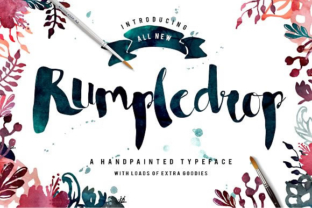
One of the first things that stands out in Rumpledrop is the deliberate irregularity of stroke thickness. Unlike geometric typefaces where every vertical and horizontal line is mathematically identical, Rumpledrop shows subtle thickening at curves and thinning at connection points. This gives the font a lively, almost tactile quality on screen. In print, even at moderate sizes, it mimics the natural flow of handwriting without crossing into illegibility. The weight distribution feels organic rather than calculated, which makes it particularly effective for headlines, pull quotes, and display text where you want warmth without whimsy.
Character Detail and Imperfection
Within the character set, there are small asymmetries that designers love. Ascenders and descenders are not uniform in length. The bowl of a lowercase 'a' might be slightly heavier on one side. Terminals are often blunt rather than perfectly rounded. These are not flaws; they are intentional markers of the handcrafted process. Rumpledrop avoids the cleaned-up, vector-smooth perfection that many digitized handwriting fonts suffer from, preserving instead a raw authenticity that resonates strongly in an era of AI-generated content.
Spacing and Rhythm
Another technical aspect where Rumpledrop excels is in its letter spacing and kerning. Many handcrafted fonts struggle with consistent rhythm because the original handwritten characters were not created on a uniform grid. Creativeqube has done careful work here, ensuring that while individual characters retain their handmade quality, the overall word shape remains readable. This makes Rumpledrop far more usable than many alternative display fonts that become visually noisy at even moderate text lengths.
Practical Applications Across Different User Groups
The versatility of Rumpledrop becomes apparent when you consider how different professionals might integrate it into their work. Its handcrafted character does not limit it to a single niche; rather, it opens up multiple use cases across industries.
Branding and Marketing Professionals
For branding specialists, Rumpledrop offers a way to differentiate clients in crowded markets. A coffee roaster using a clean minimalist logo could introduce Rumpledrop in the tagline or product naming to signal artisanal quality. A children's book publisher could use it for cover titles to evoke playfulness without sacrificing readability. Because the font retains a certain refinement through Creativeqube's design choices, it avoids looking childish or amateurish, which means it can work for premium products as well as casual ones. A wine label, a craft chocolate bar, a local bakery — these are all contexts where Rumpledrop communicates care and craft without needing any additional visual explanation.
Content Creators and Social Media Designers
In the fast-moving world of social media, standing out visually is more challenging than ever. Templates and Canva defaults have homogenized much of the visual landscape. Content creators who adopt Rumpledrop for their thumbnails, Instagram story headers, or YouTube title cards immediately introduce a distinct visual texture. It pairs beautifully with neutral background colors and organic textures like paper, wood, or fabric. Because the font has a strong personality, it carries a post's emotional tone without relying on heavy imagery. A motivational quote over a simple photograph, a product announcement over a pastel background — Rumpledrop makes the text itself the visual hero.
Educators and Instructional Designers
There is a growing recognition in educational design that typography affects cognitive load and emotional engagement. While body text should remain highly readable for long reading sessions, titles, headings, and callouts can benefit from a more expressive typeface. Rumpledrop works well for classroom posters, worksheet headers, presentation title slides, and digital course module introductions. Its handcrafted appearance signals a human presence in a digital learning environment, which can reduce the impersonal feel of online education. For younger learners especially, fonts that look made by hand can increase approachability and reduce the anxiety associated with formal instructional materials.
Small Business Owners and Solo Entrepreneurs
For business owners who manage their own branding, Rumpledrop provides a way to look professional without looking corporate. A local florist could use it for menu cards or signage. A freelance photographer could use it for watermarking or portfolio headers. A wedding stationery designer could incorporate Rumpledrop into invitation suites for a modern calligraphic feel without the cost of commissioning hand-lettering. Because Creativeqube has made the font available as a digital product, small business owners can implement it themselves across Canva, Adobe applications, or even Microsoft Office, giving their materials a cohesive, custom look.
Technical Considerations for Implementation
Using Rumpledrop effectively requires some awareness of how handcrafted fonts behave in different media. Here are practical factors to keep in mind.
Size and Legibility Thresholds
Rumpledrop performs best at display sizes — typically 24 points and above, though this depends on the resolution of the output medium. At very small sizes, the stroke variations and irregular spacing can cause letters to appear uneven or difficult to parse. For body text, pairing Rumpledrop with a clean, neutral typeface is a strong approach. A simple sans-serif like Open Sans or Lato in the body allows Rumpledrop to handle headlines and emphasis without forcing the reader to struggle through long paragraphs of irregular letterforms.
Color and Contrast
Because of its textured strokes, Rumpledrop responds well to moderate contrast rather than extreme black-on-white. A dark charcoal on an off-white background or a deep burgundy on a light cream surface often produces a softer, more integrated visual effect. On backlit screens, avoid pure white backgrounds with pure black text; the stark contrast tends to highlight the imperfections in a way that can feel jarring rather than charming. A slight tint or texture in the background helps the handcrafted quality feel intentional and grounded.
Pairing and Layering
Rumpledrop pairs naturally with minimal typography and organic graphic elements. Avoid placing it next to another highly decorative typeface, as the two can compete for attention. Instead, let Rumpledrop carry the expressive weight while accompanying elements remain restrained. It also works well in layered compositions where text sits over photographic or illustrated backgrounds, especially when the background has negative space or soft focus. The handcrafted texture creates a pleasant tension with digital imagery.
Where Rumpledrop Fits in Current Typography Trends
The broader trend toward authenticity in design has been accelerating for several years. Consumers are increasingly skeptical of overly polished, corporate visual language. They want to see evidence of human hands and human decisions. This has driven interest in imperfect textures, analog production methods, and handcrafted digital assets. Rumpledrop arrives at a moment when designers across disciplines are seeking typefaces that feel personal yet remain functional.
In web design, the monotony of system fonts and generic Google Fonts has prompted many developers and designers to invest in custom type libraries that give their sites a distinct voice. Rumpledrop fits this brief perfectly. It is unique enough to be memorable, but not so eccentric that it distracts from content. For landing pages, coming-soon notices, hero sections, and blog headers, it introduces differentiation without sacrificing professionalism.
In print, particularly in small-batch publishing and independent magazines, Rumpledrop offers editorial teams a way to reinforce their identity. A feature headline set in Rumpledrop signals that the story inside might be personal, opinionated, or creative. It becomes part of the editorial framing, not just a vessel for words.
Observations from Real-World Usage
Designers who have incorporated Rumpledrop into their workflows often note two reactions from audiences. First, viewers frequently comment on the font itself, unprompted, which is unusual. Most typography is invisible; people read through it without noticing. But Rumpledrop tends to draw positive attention. It makes people stop and look. Second, the font seems to confer a sense of care upon the content that uses it. A poster set in Rumpledrop feels more considered than the same design in Arial or Helvetica, even if nothing else changes. This halo effect is precisely what makes handcrafted fonts valuable in competitive visual environments.
One interior designer reported using Rumpledrop for a client's brand mood board, and the client specifically asked where the handwriting came from, assuming it was custom lettering. That level of engagement is difficult to achieve with conventional typography. Another user, a teacher creating classroom decor, noted that students responded more positively to labeled bins and bulletin boards set in Rumpledrop compared to the same content in a standard font. These anecdotes reinforce that the font's handmade quality triggers something in viewers that polished type does not.
Choosing Rumpledrop for Your Next Project
Whether you are designing a brand identity, laying out a publication, building a course, or creating content for social media, Rumpledrop offers a distinctive tool for communicating warmth, intentionality, and human touch. Creativeqube has crafted a typeface that respects the tradition of hand-drawn lettering while meeting the technical needs of modern design workflows. It does not require special software or plugins, it works across major design platforms, and it integrates smoothly into both digital and print projects.
When considering whether Rumpledrop fits your specific use case, ask yourself whether the project benefits from a human visual signature. If you want the audience to feel that a person made this, that there was an artist involved, that the design is not just functional but expressive, then Rumpledrop is worth serious consideration. For projects where complete neutrality and invisibility are the goals, a simpler typeface may be more appropriate. But for projects where you want your text to stand up and announce itself with character, Rumpledrop delivers.
In a landscape saturated with identical-looking interfaces and templated content, any design choice that introduces genuine distinctiveness is an asset. Rumpledrop, through its handcrafted construction and careful digitization by Creativeqube, provides exactly that: a typographic voice that is clearly, unmistakably human.