Metal Ink: A Practical Evaluation of a Clean Handwritten Font
When evaluating display fonts for branding, packaging, or editorial design, handwritten typefaces occupy a distinct space. They offer personality without the rigidity of geometric sans-serifs, yet they can lack the legibility of more traditional scripts. Metal Ink is a clean handwritten font designed to help users create lettering designs with minimal friction. This evaluation examines what Metal Ink is, who might benefit from it, and where alternative choices may be more appropriate. The goal is to provide practical insights for designers, marketers, and content creators evaluating whether Metal Ink aligns with their specific project needs.
What Metal Ink Is
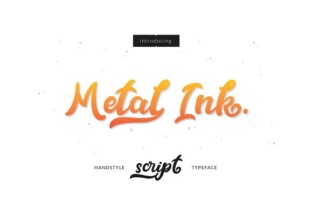
Metal Ink is a handwritten font characterized by clean, consistent strokes and a balanced letterform structure. Unlike many script fonts that emphasize flourish-heavy swashes or uneven baseline rhythms, Metal Ink prioritizes readability while retaining a hand-drawn aesthetic. The typeface sits in the category of clean handwritten fonts—styles that bridge informal, personal lettering with the polish required for professional use.
The font includes uppercase and lowercase characters, numerals, and standard punctuation. Its letterforms are designed with moderate contrast, meaning the thick-to-thin transitions are present but not extreme. This makes the font suitable for both headline use and shorter body-text applications where a human touch is desired. The overall impression is approachable without being casual, and intentional without being stiff.
Reasons Someone Might Be Interested in Metal Ink
Interest in Metal Ink typically arises from a need for authenticity in digital or print design. Many users find that standard script fonts feel overly mechanical, while more expressive handwritten fonts can be difficult to read at smaller sizes. Metal Ink attempts to balance these concerns. Common motivations for exploring this font include:
- Brand identity design: Brands seeking a friendly, artisanal, or handmade feel often turn to clean handwritten fonts. Metal Ink provides a consistent baseline that works across logos, packaging, and social media graphics.
- Editorial and layout work: Designers working on magazines, blogs, or promotional materials sometimes use handwritten fonts for pull quotes, subheadings, or accent text. The legibility of Metal Ink makes it a candidate for these roles.
- Product packaging: Small-batch products, organic goods, and craft-oriented items frequently use handwritten typography to communicate authenticity. Metal Ink offers a clean option that doesn't overwhelm the label design.
- Digital content creation: Social media graphics, YouTube thumbnails, and website hero sections often benefit from a handwritten accent. Metal Ink's clean forms render well on screens without excessive aliasing or blurring.
Benefits and Tradeoffs of Metal Ink
Every typeface involves tradeoffs, and Metal Ink is no exception. Understanding these tradeoffs helps users determine whether the font supports or undermines their project goals.
Benefits
Legibility at multiple sizes. One of the strongest arguments for Metal Ink is its readability. The open counters and consistent stroke weight mean that even at smaller point sizes, the letterforms remain distinct. This is not always true for handwritten fonts, where flourishes or uneven spacing can reduce clarity.
Versatility across media. Metal Ink works in both print and digital environments. The clean line art reduces issues with ink bleed in print and with antialiasing artifacts on screens. For designers who need one font that functions in multiple contexts, this reduces file management and testing overhead.
Neutral personality. While the font clearly reads as handwritten, it avoids strong stylistic associations. It does not lean heavily into vintage, modern, grunge, or calligraphic aesthetics. This neutrality makes it adaptable to a range of brand voices and design languages.
Tradeoffs
Limited expressive range. Because Metal Ink is designed for cleanliness, it sacrifices some of the organic variation found in more expressive handwritten fonts. Designers seeking a raw, uneven, or highly textured hand-lettered look may find Metal Ink too polished. The font's consistency, while a strength for legibility, can feel uniform across longer passages.
Not optimized for extended body text. Like most handwritten fonts, Metal Ink is best suited for short-form applications. Long paragraphs set in Metal Ink may cause reader fatigue due to the irregular baseline and rhythmic patterns inherent in script styles. For extended reading, a serif or sans-serif body font is typically more appropriate.
Standard character set. Metal Ink includes the basic Latin character set but may not offer extensive ligatures, alternates, or stylistic sets. Users who rely on advanced OpenType features for dynamic typesetting may find the font functionally simple. This is a consideration for logo work where custom letter variations add value.
Situations Where Metal Ink Is a Strong Fit
Metal Ink performs well in scenarios where readability and handwritten authenticity are both required. Specific use cases include:
- Small business branding: Local shops, cafés, bakeries, and service providers often need a font that feels personal without looking amateurish. Metal Ink provides a reliable option for storefront signage, menu headers, and business cards.
- Social media templates: Content creators who post regularly benefit from a consistent handwritten accent across posts. Metal Ink's clean rendering at various screen resolutions supports cohesive visual branding.
- Event materials: Wedding invitations, party flyers, and workshop handouts frequently use handwritten fonts. Metal Ink's legibility ensures that event details remain readable while maintaining a handcrafted look.
- Educational resources: Worksheets, classroom posters, and instructional materials sometimes use handwritten fonts to feel approachable. Metal Ink's clarity helps students read content without distraction.
Situations Where Alternatives May Be Worth Considering
No single font suits every project, and Metal Ink has limitations that make alternatives more appropriate in certain contexts.
If you need a highly expressive or distressed look. Grunge-style handwritten fonts, marker fonts, or brush scripts offer more texture and irregularity. For projects that require a rough, industrial, or heavily organic feel, Metal Ink's clean lines may appear too controlled. Fonts like Blacklisted or Havana provide more edge.
If you require extensive OpenType features. Designers building complex wordmarks or logotypes often rely on ligatures, stylistic alternates, and swashes to create unique lockups. Metal Ink's standard character set may not offer the depth needed for this kind of customization. Fonts like Thirsty Script or Bickham Script offer richer feature sets.
If you need a font for long-form reading. For articles, reports, or book text, a serif or sans-serif typeface designed for extended reading is a better choice. Metal Ink, like most handwritten fonts, is not optimized for paragraph-length content. Pairing Metal Ink with a neutral body font such as Lato or Merriweather may be a practical middle ground.
If the brand tone is formal or corporate. Clean handwritten fonts can feel too casual for law firms, financial institutions, or high-end corporate communications. In these contexts, a refined serif or a modern sans-serif typically communicates the desired level of professionalism.
Practical Decision-Making Insights
When evaluating Metal Ink for a specific project, consider the following questions as part of your decision process:
- What is the primary use context? If the font will appear in short headlines, quotes, or accent text, Metal Ink is a strong candidate. If it needs to carry extended body copy, look elsewhere or plan a type pairing strategy.
- What tone does the brand require? Metal Ink sits in the middle of the tone spectrum—approachable but not casual, polished but not formal. Assess whether this alignment matches your brand voice. If you need something warmer or more reserved, adjust accordingly.
- How much typographic control do you need? If your workflow relies on alternates and custom letter variations, verify that Metal Ink's character set supports your needs. For straightforward lettering, the standard set is sufficient.
- Where will the font be rendered? Test Metal Ink at the intended display sizes and across the media you use—web, mobile, print. Its clean design generally performs well, but testing is always advisable.
- What is your fallback option? Even if Metal Ink fits your primary use case, consider a secondary font for supporting text. A clean sans-serif like Open Sans or Montserrat pairs well with Metal Ink for headers and subtext.
Determining Whether Metal Ink Aligns with Your Goals
Metal Ink is a practical tool for designers who need a clean handwritten font that prioritizes legibility and adaptability. It does not attempt to be the most expressive or feature-rich script on the market. Instead, it serves as a reliable workhorse for projects where a personal touch must coexist with professional clarity.
For users whose primary need is a font that reads well at various sizes, works across print and digital media, and communicates a neutral handmade quality, Metal Ink delivers consistent results. For users seeking high stylistic variation, extensive typographic features, or a font suited to long-form reading, alternatives will likely serve better.
Ultimately, the decision rests on matching the font's characteristics to the specific demands of your project. By evaluating factors such as tone, use context, feature requirements, and rendering environment, you can determine whether Metal Ink is the right choice or simply one option among many worth considering.