Sideline: A Handcrafted Font That Brings Personality to Digital Design
Typography has a way of shaping how we perceive a brand, a message, or even a moment. In a world where digital communication often leans toward sterile uniformity, the return to handcrafted lettering feels like a breath of fresh air. Sideline, a beautiful handcrafted font created by Creativeqube, embodies this shift with remarkable grace. It is not just another typeface—it is a carefully sculpted design tool that carries the warmth and irregularity of human hands while remaining polished enough for professional use.
What Makes Sideline Distinctive
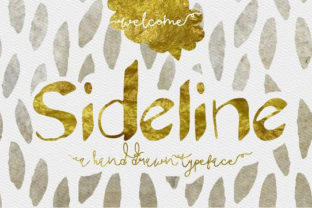
At first glance, Sideline reveals its handcrafted roots. Each character carries subtle variations in stroke weight, slight asymmetries, and organic curves that no algorithm can replicate. Creativeqube approached this font with an artisan's mindset, treating each glyph as a standalone piece of art that still needed to function cohesively within a complete alphabet.
The font sits comfortably in the display category, meaning it thrives at larger sizes where its details can breathe. Unlike many script or handwritten fonts that feel overly casual or sloppy, Sideline strikes a careful balance. It has structure without stiffness, personality without chaos. The letterforms maintain legibility even as they embrace irregularity, which is a surprisingly difficult achievement for any handcrafted typeface.
Creativeqube paid particular attention to how letters connect and interact. In Sideline, you will notice that certain letter pairs flow naturally into one another, while others maintain a deliberate separation. This rhythmic variation prevents the monotony that plagues many script fonts and gives the text a dynamic, living quality.
The Role of Handcrafted Fonts in Contemporary Design
There is a growing hunger for authenticity in visual communication. Audiences have become remarkably adept at spotting templated design, and they respond more favorably to work that feels intentional and human. Handcrafted fonts like Sideline fill this gap perfectly. They signal that someone cared enough to make choices, to leave marks, to create something that could not have been generated by a machine at the push of a button.
This is especially relevant in industries where trust and emotional connection matter. Small businesses, creative agencies, lifestyle brands, and independent publications all benefit from typography that feels grounded and real. Sideline offers these projects a way to differentiate themselves without resorting to gimmicks. It is distinctive enough to be memorable but restrained enough to remain versatile.
Consider how branding has evolved over the past decade. The shift from cold minimalism toward warmer, more expressive identities has opened the door for typefaces that bring texture and mood. Sideline fits neatly into this landscape. It can anchor a brand's visual identity or serve as an accent that adds character to an otherwise neutral design system.
Practical Applications Across Projects and Industries
One of the most compelling aspects of Sideline is its flexibility across different media. While it was clearly designed with display usage in mind, its applications extend far beyond headlines and logos.
For packaging design, Sideline brings a handmade quality that pairs beautifully with natural materials, craft products, and artisanal goods. A jar of honey, a box of handmade chocolates, or a bottle of small-batch hot sauce all gain authenticity when their labels use a typeface that looks like it was written by hand. The font's organic shapes complement rough paper textures, foil stamping, and letterpress techniques exceptionally well.
In digital contexts, Sideline works wonders for hero headers, landing page titles, and social media graphics. The contrast between a clean sans-serif body font and Sideline as a display face creates immediate visual hierarchy. Readers instinctively understand that the headlines matter, and the human quality of the lettering invites them to slow down and engage.
Wedding invitations, greeting cards, and event posters represent another natural fit. Couples and event planners often struggle to find typography that feels personal without being overly decorative. Sideline offers a middle ground. It reads as elegant but not formal, personal but not precious. It can carry the weight of a couple's names on an invitation or add warmth to a save-the-date card without overwhelming the design.
Creativeqube also designed Sideline with editorial use in mind. Magazine pull quotes, section headers, and feature titles benefit from the font's expressive character. In layouts where body text remains clean and straightforward, Sideline injects moments of visual interest that guide the reader through the content naturally.
Technical Considerations and Workflow Integration
Before adopting any handcrafted font, designers should understand its technical characteristics and how it performs across different environments. Sideline includes multiple weights and stylistic alternates, which gives users room to play with variation without switching typefaces.
The font handles well in vector-based design software like Adobe Illustrator and Affinity Designer, where you can adjust kerning pairs and fine-tune spacing. Creativeqube built standard ligatures into the character set, so common letter combinations automatically appear more natural. This reduces the amount of manual tweaking required during layout, which is a genuine time saver for working designers.
Web performance is another factor worth considering. Sideline loads efficiently as a web font when served through standard CDN integrations. Its file size remains reasonable for a handcrafted display font, and it renders consistently across modern browsers. For designers building websites that rely on typographic impact, Sideline offers a reliable option that does not sacrifice speed for style.
One practical recommendation is to use Sideline at sizes above 24 points for optimal readability. At smaller sizes, the handcrafted details can become lost or cause visual noise. Pairing Sideline with a clean, neutral sans-serif font for body text creates a balanced system where each typeface plays to its strengths.
The Philosophy Behind Creativeqube's Approach
Creativeqube has built a reputation for fonts that prioritize character over conformity, and Sideline exemplifies this philosophy. The foundry understands that handcrafted typography is not about perfection—it is about presence. Every slight wobble, every uneven curve, every moment where the pen lifted at a slightly unexpected angle contributes to the font's overall personality.
This approach resonates with designers who are tired of sanitized visual language. In an era where so much communication feels automated, Sideline offers a reminder that design is still a human activity. It encourages makers to embrace imperfection as a feature rather than a flaw.
Creativeqube also ensures that their fonts are built to modern standards. Sideline includes OpenType features, extended character sets for multilingual support, and carefully crafted punctuation and numerals. These details matter when a font moves from concept to real-world application. Nothing breaks immersion faster than a beautiful alphabet that cannot handle an ampersand or a curly quote properly.
Observations on Choosing Sideline for Your Next Project
Designers evaluating Sideline should think about the emotional tone they want to set. This font leans warm, approachable, and slightly nostalgic without feeling dated. It works exceptionally well for projects that want to communicate craftsmanship, care, and attention to detail.
If your project involves children's products, lifestyle blogging, handmade goods, or creative services, Sideline can serve as a visual shortcut for quality. It tells the audience that the brand values authenticity and has invested in its visual identity beyond stock templates.
On the other hand, Sideline may not be the best choice for highly corporate or technical environments where neutrality and strict professionalism are expected. It is a font with opinions, and those opinions should align with the message you are delivering.
Budget is another practical consideration. Handcrafted fonts from reputable foundries like Creativeqube represent an investment, but they also come with proper licensing, technical support, and regular updates. For commercial projects, this reliability is worth the cost compared to free alternatives that often lack glyph completeness or have inconsistent spacing.
The Broader Context of Typography Trends
Observing the current landscape of typography, it is clear that display fonts with handmade qualities are not a passing trend. They respond to a deeper cultural shift toward valuing the human touch in an increasingly digital existence. Sideline participates in this movement, but it does so with a level of refinement that keeps it relevant beyond any single trend cycle.
Creativeqube has designed a font that feels both timely and durable. It captures the current appetite for authenticity while possessing the structural integrity to remain useful as styles evolve. This is the hallmark of good type design—it serves the present without becoming trapped by it.
For designers building portfolios, client work, or personal projects, Sideline offers a reliable way to introduce warmth and character. It is a tool that invites experimentation while maintaining professional standards. Whether used sparingly as an accent or boldly as a primary display face, it brings something genuinely human to the page.
Final Observations on Working with Sideline
Typography decisions often come down to a subtle test—can you imagine the design without it? With Sideline, the answer is frequently no. Once you place it into a layout, it becomes an integral part of the visual identity. The font earns its place through a combination of beauty and utility that is rarer than it should be in a crowded market.
Creativeqube has given designers a tool that rewards close attention. The more you work with Sideline, the more you notice the thoughtful details—the way certain letters tilt slightly, the variation in loop sizes, the careful spacing that prevents the font from feeling rushed or sloppy. These are the marks of a handcrafted typeface made by people who understand both art and craft.
If you are looking for a font that brings genuine personality to your projects without compromising on technical quality, Sideline deserves serious consideration. It is a beautiful handcrafted font by Creativeqube that manages to feel both personal and professional, a combination that is harder to find than it should be. Whether you are designing a brand identity, a wedding suite, a website, or a product label, Sideline offers a voice that is unmistakably human. And in a world of endless digital noise, that might be exactly what your next project needs.