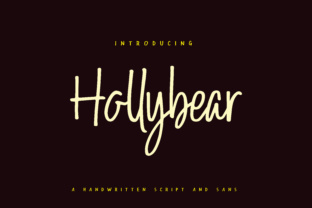
Hollybear: A Handwritten Monoline Font Duo with Script, Regular, and Bonus Swashes
Typography often walks a fine line between personality and legibility. For designers, finding a typeface that feels genuinely human without sacrificing readability can be a challenge. Enter Hollybear, a handwritten monoline font duo that brings warmth, consistency, and versatility to a wide range of projects. Unlike many script fonts that feel overly decorative or stylized, Hollybear strikes a balance that feels both approachable and professional. Whether you are designing for print, digital, branding, or social media, this font duo offers distinct options that adapt to your creative needs.
What Makes Hollybear Stand Out as a Monoline Font Duo
At its core, Hollybear is a monoline font, meaning the stroke thickness remains consistent throughout each character. This uniformity gives it a clean, modern appearance that works well in both large headlines and body text. Many handwritten fonts suffer from uneven weight distribution, which can make them difficult to read at smaller sizes. Hollybear avoids that pitfall entirely. The monoline structure ensures that every letterform remains crisp and legible, regardless of scale or application.
The font comes in two primary styles: script and regular. The script version captures the flow of natural handwriting, with connected letters that mimic the rhythm of a pen on paper. The regular style offers a more straightforward, print-like appearance, with individual characters that stand independently. Together, these two styles form a cohesive system that allows designers to mix and match depending on the mood and structure of their project.
What truly elevates Hollybear, however, is the inclusion of bonus swashes. These decorative flourishes add flair to the script style, enabling you to create ornate beginnings, endings, or accents within words and phrases. Swashes can transform a simple heading into something elegant and eye-catching without requiring additional illustration or embellishment. They give designers a toolkit for customization that feels organic rather than forced.
The Practical Benefits of a Script and Regular Duo
Having both script and regular versions within a single font family is more useful than you might initially think. In practice, this duality allows you to establish hierarchy and contrast without switching between entirely different typefaces. For example, you might use the script style for a headline or logo wordmark, then switch to the regular style for supporting text, captions, or body copy. The visual connection between the two styles ensures that your design remains cohesive, even as you vary the typographic treatment.
This approach is particularly valuable in branding and identity work. A brand needs consistency across touchpoints, but it also needs flexibility. With Hollybear, you can maintain a handwritten aesthetic throughout a website, business card, packaging, and social media graphics without relying on a single, static type style. The regular version provides the readability needed for longer text, while the script version brings personality to short, impactful phrases.
Another practical consideration is file size and licensing. Using a single font family that offers multiple styles simplifies your font management and reduces the number of licenses you need to track. For freelancers, small studios, and in-house designers, this efficiency can save both time and money without sacrificing creative options.
Where Hollybear Fits Into Modern Design Workflows
Handwritten fonts have experienced a resurgence in recent years, driven by a desire for authenticity and human connection in digital spaces. Consumers are increasingly drawn to brands and content that feel personal, approachable, and less corporate. Hollybear aligns perfectly with this shift. Its natural, unforced letterforms evoke the feeling of a handwritten note or journal entry, which can help establish trust and warmth with an audience.
In modern design workflows, Hollybear is versatile enough to be used across multiple platforms. For web design, the font works well in hero sections, headings, call-to-action buttons, and quote highlights. Its monoline structure ensures that it renders cleanly on screens of all sizes, from mobile phones to large desktop monitors. Because the stroke weight is consistent, you do not have to worry about thin hairlines disappearing or thick strokes feeling overwhelming on high-resolution displays.
For print projects, Hollybear performs beautifully in invitations, greeting cards, product packaging, labels, and signage. The included swashes add an extra layer of sophistication to printed materials, allowing you to create custom lettering effects that stand out on physical products. Event planners, stationery designers, and small business owners will find particular value in the font's ability to elevate simple text into something memorable.
Social media content creators also benefit from Hollybear's range. Whether you are designing Instagram quotes, YouTube thumbnails, Pinterest pins, or LinkedIn banners, having both script and regular styles lets you maintain a consistent brand voice across platforms. The swashes can be used to frame text, create dividers, or add decorative touches that make your content feel curated and intentional.
Key Characteristics That Define Hollybear's Personality
Hollybear is not just functional; it has a distinct personality that influences how your message is perceived. The script style carries a gentle, flowing quality that feels friendly and inviting. It is not overly formal or rigid, nor is it too casual or messy. This middle ground makes it suitable for a wide range of tones, from heartfelt and sentimental to cheerful and energetic.
The regular style, by comparison, is more grounded and practical. It retains the handwritten feel but with a structured, deliberate appearance. This makes it easier to read in paragraphs or longer blocks of text, where a full script would become visually overwhelming. Designers can use the regular style for informational content while using the script style for emotional or emphasis-driven text.
The bonus swashes deserve special attention because they are not an afterthought. They are designed to integrate seamlessly with the script characters, extending ascenders, descenders, and connecting strokes in ways that look natural. This is important because poorly designed swashes can disrupt the flow of text and draw attention to themselves in a distracting way. Hollybear's swashes are subtle enough to enhance without overpowering, giving you the flexibility to use them sparingly or generously depending on the effect you want to achieve.
Scenarios and Recommendations for Using Hollybear
If you are working on a wedding invitation suite, Hollybear's script style combined with a few well-placed swashes can create an elegant, romantic look. Pair it with a simple sans-serif or serif body font for the details, or use the regular style for addresses and secondary text to maintain the handwritten theme without sacrificing legibility.
For a small business logo, consider using the script style for the brand name and the regular style for a tagline or descriptor. This gives you a cohesive identity that feels personal and crafted. The monoline nature of the font ensures that the logo remains readable when scaled down for social media avatars or favicons.
In editorial design, such as a blog or magazine layout, Hollybear can be used for pull quotes, section headers, or introductory paragraphs. The regular style works well for shorter blocks of body copy, especially in sidebar or callout sections where you want to break away from the main typeface without losing consistency.
For product packaging, particularly in the food, beverage, beauty, and wellness industries, handwritten fonts convey a sense of artisanal quality. Hollybear's clean lines keep the packaging looking modern rather than rustic or old-fashioned. The swashes can be used to frame ingredient lists, flavor names, or brand mottos in a way that feels designed rather than arbitrary.
Considerations Before Choosing Hollybear
Like any typeface, Hollybear is not a one-size-fits-all solution. Its handwritten nature means it works best in contexts where a personal, human touch is desirable. For highly formal corporate documents, legal contracts, or academic publications, a more traditional serif or sans-serif font would be more appropriate. Understanding the tone and expectations of your audience is essential before committing to any handwritten font.
Another consideration is language support. While Hollybear covers a solid range of Latin characters, you should verify that it includes the specific glyphs, accents, and punctuation you need for your target languages. This is especially important for multilingual projects or international branding efforts.
Licensing is also worth examining. Font duo families like Hollybear often come with standard desktop licenses, but if you plan to use the font for web embedding, mobile apps, or commercial products, be sure to check whether an extended license is required. Investing in the right license upfront prevents legal headaches and ensures you can use the font freely across your projects.
Finally, consider how Hollybear will pair with other typefaces in your design system. Because it has a distinct personality, it works best when paired with neutral, understated fonts that do not compete for attention. Clean sans-serifs like Open Sans, Lato, or Montserrat are safe choices. For a more traditional contrast, a classic serif like Playfair Display or Georgia can complement Hollybear's handwritten curves.
Final Observations on Hollybear's Place in Your Toolkit
Hollybear represents a thoughtful approach to handwritten typography. By offering both script and regular styles along with bonus swashes, it gives designers the flexibility to create layered, expressive typographic compositions without leaving the comfort of a single font family. Its monoline construction ensures readability and consistency, while the organic letterforms keep designs feeling human and approachable.
In a design landscape where authenticity is increasingly valued, Hollybear provides a tool that helps brands and creators communicate with warmth and clarity. Whether you are designing a logo, a wedding invitation, a social media campaign, or a product label, this font duo gives you the range to match the message. The key is to use its strengths intentionally, letting the script shine in moments of emphasis and the regular style carry the weight of longer content.
When you add Hollybear to your font library, you are not just acquiring a typeface. You are gaining a versatile system that supports your creative process from concept to execution. And with the bonus swashes included, you have the freedom to add flourishes that elevate your designs from good to memorable. If you value typography that feels natural, works hard across formats, and brings a genuine voice to your projects, Hollybear deserves a close look.