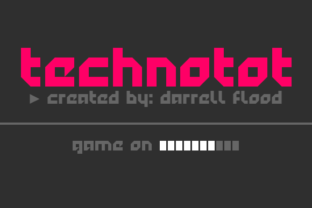
Technotot: Where Minimalist Design Meets Futuristic Vision
If you have ever tried to build a user interface that genuinely feels like it belongs in the next decade, you have likely run into the same problem. Most fonts look fine, but they do not carry any atmosphere. They work for blogs and dashboards, but when you need something that suggests speed, precision, and a slightly cold, advanced sensibility, the usual options fall flat. That is where Technotot enters the picture. Created by type designer Darrell Flood, Technotot is a minimalist font built around clean, angular geometry. It does not try to imitate handwriting or warm serif traditions. Instead, it leans into the kind of structured, machine-readable clarity that feels at home on a spaceship console or a next-gen hardware interface.
Angular, in this context, refers to the deliberate use of sharp, geometric letterforms that communicate efficiency and forward-thinking design. Technotot embraces that angularity without sacrificing readability. It is not decorative in the way a display font might be, but it carries a distinct personality that changes how people perceive the content it sets. For designers, product builders, and content creators who work with futuristic or tech-heavy themes, Technotot offers something that goes beyond mere aesthetics. It becomes part of the message itself.
What Technotot Actually Does Differently
Most minimalist fonts aim for neutrality. Helvetica, Roboto, and similar workhorses are designed to stay out of the way. Technotot takes a different approach. It is minimalist, yes, but it still asserts a clear visual identity. The letterforms are compact, with tight spacing and a consistent stroke width that gives text a uniform, almost engineered look. This makes it particularly effective in situations where you need to convey precision and reliability.
Darrell Flood designed Technotot with a specific eye toward science fiction and futuristic contexts. That does not mean it only works in overtly sci-fi settings. It means the font carries associations that audiences pick up on subconsciously. When someone reads a headline set in Technotot, they do not necessarily think "this is a sci-fi font." They might just feel that the information seems more authoritative, more technical, or more innovative. That subtle perceptual shift is valuable in many real-world applications.
Where Technotot Shines in Real Projects
The practical usefulness of Technotot goes well beyond theoretical design exercises. People are already using it in a variety of industries and contexts, often with noticeable results.
User Interfaces for Hardware and Software Products
If you are building an interface for a physical device like a smart home hub, a medical monitor, or an automotive display, the font you choose matters in ways that go beyond branding. On small screens with limited resolution, a font with clean, open shapes and consistent stroke widths remains legible where more ornate options become muddy. Technotot works well here because its angular forms do not rely on subtle curves that disappear at small sizes. It reads clearly even when space is tight.
In software applications, particularly those targeting developers, engineers, or data analysts, Technotot can reinforce a sense of reliability. A code editor, a monitoring dashboard, or a cybersecurity tool benefits from a font that feels precise and no-nonsense. It signals that the tool was built with care and that the information presented can be trusted.
Branding and Visual Identity for Tech Companies
A startup building a product in the AI, robotics, or renewable energy space faces a branding challenge. They need to appear modern without looking generic, and they need to communicate innovation without alienating potential customers who might not be tech-savvy. Technotot offers a middle ground. It is distinctive enough to create a memorable brand mark or headline treatment, but it does not veer into the kind of extreme styling that only works in niche contexts. Pair it with a neutral sans-serif for body text, and you get a visual system that feels both advanced and approachable.
One practical example is a company that develops autonomous drone software. Their website uses Technotot for all major headings and key performance metrics displayed on their product pages. The font gives those numbers an authoritative, data-driven feel. Visitors perceive the company as more credible, not because the font is flashy, but because it aligns with the visual language of precision technology.
Event and Conference Materials
Tech conferences, futurist summits, and innovation expos often struggle with visual consistency across a wide range of materials, from signage to slide decks to printed programs. Technotot works well in this context because it maintains its character at multiple scales. On a large banner, the angular shapes create a strong visual impact. On a small name badge, the text remains crisp and readable. Organizers who adopt Technotot for their event identity often find that materials look more cohesive without requiring constant design adjustments.
Motion Graphics and Video Titles
In video content, especially explainer videos, product demos, or channel branding for tech-focused audiences, text needs to be readable in motion. Fonts with thin strokes or complex details tend to blur or flicker when animated. Technotot is robust enough to hold up well in motion. Its even stroke width and straightforward geometry mean it looks clean whether it is fading in, sliding across the screen, or sitting static in a lower third title. Creators working on YouTube channels about space exploration, futurology, or engineering often gravitate toward Technotot for exactly this reason.
How Different Users Benefit in Different Ways
The beauty of a well-designed font like Technotot is that it serves different purposes depending on who is using it and what they are trying to achieve.
A UI designer working on a vehicle infotainment system might choose Technotot because it meets strict legibility requirements at small sizes while also contributing to a premium, minimalist look. The angular forms echo the geometric lines often found in automotive interiors, creating a cohesive visual experience.
A marketing professional promoting a new cybersecurity platform might use Technotot in campaign headlines to visually differentiate from competitors who rely on the same handful of popular fonts. The distinctive letterforms help the brand stand out in a crowded field where most ads look similar.
A content creator producing videos about theoretical physics or space colonization can use Technotot in video titles and thumbnail text to instantly communicate a futuristic tone. The audience does not need to consciously register the font choice. They simply sense that the content matches the visual presentation.
A game developer building a sci-fi title might use Technotot for in-game UI elements, menu screens, or even subtitles. The font supports the immersive world without pulling attention away from the action. It feels native to the setting.
Practical Considerations Before Adopting Technotot
Technotot is not a universal solution, and that is a strength, not a flaw. Knowing when and where to use it comes down to understanding a few key considerations.
Context matters more than personal preference. If your project is aimed at a general consumer audience and the subject matter is warm, human, or traditional, Technotot might feel out of place. It carries a cool, technical personality that works best when that aligns with the product or message. For a legal website or a bakery brand, there are better options.
Pairing it with other typefaces requires thought. Technotot works best as a display or heading font rather than long-form body copy. For paragraphs of text, it can feel dense and fatiguing to read. Pair it with a highly readable body font like Source Sans, IBM Plex Sans, or even a clean serif for contrast. The combination of a sharp heading in Technotot with a comfortable body font creates a balanced hierarchy.
Licensing and availability matter for commercial projects. Before committing to Technotot for a client project or a product you plan to sell, check the license terms. Fonts created by independent designers like Darrell Flood often come with specific usage rights. Make sure your use case, especially in web applications or embedded software, is covered.
Testing at different sizes and on different screens is essential. Fonts that look perfect in a design tool can behave differently on actual hardware. Test Technotot on the smallest screen your audience will use, whether that is a smartwatch, a phone, or a vehicle display. Confirm that the spacing and clarity hold up in real-world conditions.
Strengths and Honest Limitations
Technotot brings real strengths to the table. Its angular geometry is distinctive without being distracting. It reads well at small sizes, which makes it suitable for interfaces where every pixel counts. It carries a strong thematic association with futuristic and technical contexts, which can amplify a brand or product message without extra effort. And it comes from a designer, Darrell Flood, who understands how type behaves in both static and motion environments.
On the limitation side, Technotot is not the most versatile font in a typical library. It works best in specific contexts and can feel mismatched if used in the wrong setting. It does not offer multiple weights or extended character sets in every version, so check whether the specific weight you need supports the languages your audience uses. It also requires intentional pairing with other fonts for body text, which adds a small amount of complexity to the design process.
Those limitations are not dealbreakers. They simply mean Technotot is a specialized tool. Used where it fits, it elevates the work. Used where it does not fit, it fights against the content. The key is knowing which situation you are in.
For anyone building products, content, or experiences aimed at an audience that values innovation, precision, and a forward-looking aesthetic, Technotot is worth serious consideration. It brings a specific kind of visual authority that generic fonts cannot replicate. And in a world where first impressions are formed in seconds, that authority can make a real difference.